
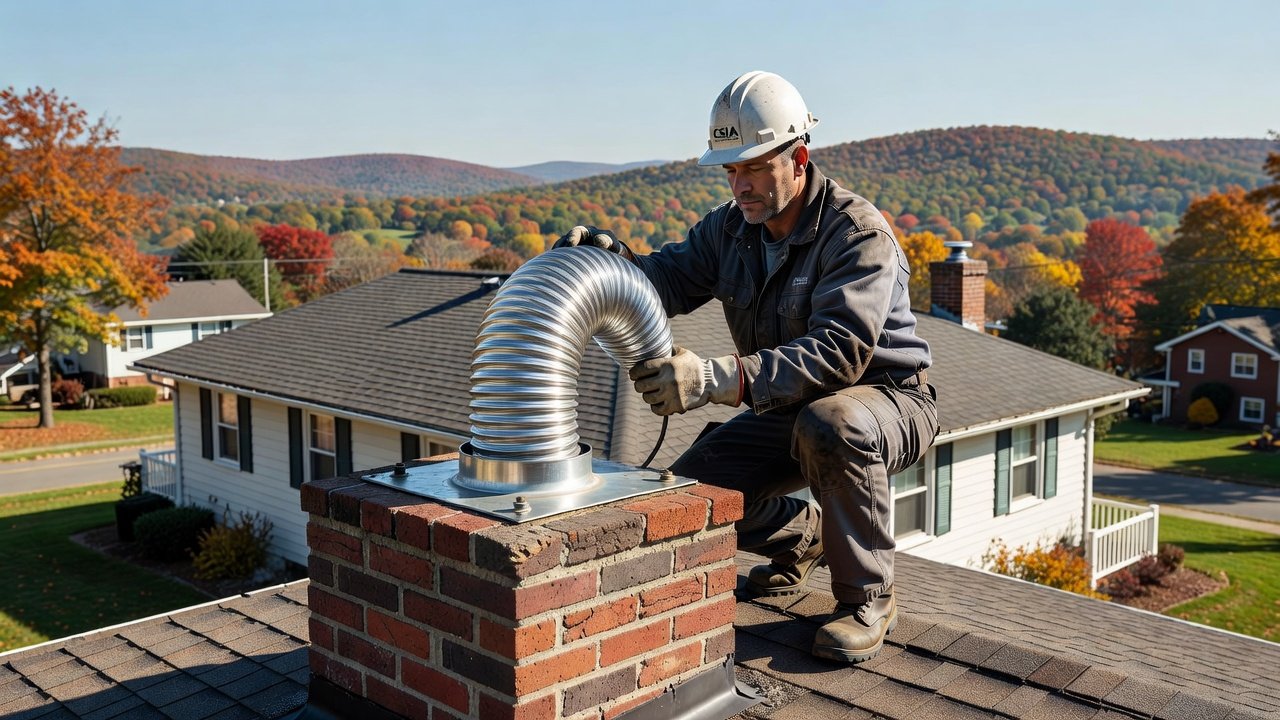
Chimney Liner Installation in Tappan, NY
A chimney liner is the protective sleeve running from your firebox or appliance flue collar all the way up through the chimney to the crown it contains combustion gases, channels them safely out of the house, and shields the surrounding masonry from heat and corrosive byproducts. Without a sound liner, those gases have nowhere to go but sideways: through hairline cracks in the flue tiles, into wall cavities, and eventually into living spaces. Chimney liner installation is the process of fitting a correctly sized, code-compliant liner to restore that critical barrier and it is one of the most consequential safety upgrades a Tappan homeowner can make.
If that sounds serious, it is. But it is also a straightforward project when it is done by someone who works these houses every week.
The Problem That Usually Brings Rockland County Homeowners to This Page
Most people do not call us asking for a liner. They call because a Level II inspection after a house sale flagged a deteriorated flue. Or because they just had a gas insert installed and the appliance dealer told them the existing clay tile liner is too large for the new unit. Or and we hear this more than you might think because their HVAC contractor noticed backdrafting on the new furnace and traced it to an unlined or improperly sized flue.
Tappan sits in the Hudson Valley, and a meaningful share of the homes here were built in the mid-20th century when terra-cotta flue tiles were the standard. Those tiles crack. The mortar joints between them fail. A house that has gone through thirty-plus heating cycles, a few freeze-thaw winters, and one or two chimney fires will very often have a liner that cannot do its job anymore. That is not a criticism of the original builders it is just physics and time.
A new liner does not just fix the safety problem. It also sizes the flue correctly to the appliance, which improves draft, reduces creosote accumulation, and often lowers heating bills because the system runs more efficiently.
Which Liner Is Right for Your Chimney and Appliance?
There is no single answer, and anyone who quotes you a liner without asking about your appliance first is guessing. The three main options each have a specific best use:
- Flexible stainless-steel liner (most common): A corrugated stainless tube typically 304 or 316 alloy depending on the fuel type that can navigate offsets in older chimneys. Ideal for gas inserts, wood stoves, oil appliances, and most retrofit situations. Comes in AL 29-4C alloy for high-efficiency condensing appliances that produce acidic condensate.
- Rigid stainless steel liner: Sections of straight pipe used when the flue runs perfectly plumb with no offsets. Slightly better draft performance than flexible liner, but only practical in a minority of Tappan-area chimneys given their age and construction.
- Cast-in-place liner (HeatShield or similar): A pourable or pumped refractory cement system that bonds to the existing masonry, sealing cracks and restoring structural integrity without removing the old tiles. Well suited for wood-burning fireplaces where the flue geometry is already correct but the tiles have deteriorated.
We carry both 304 and 316 stainless flexible liner stock, and we are certified to apply HeatShield cast-in-place systems. Choosing correctly depends on your fuel source, appliance BTU output, the number of offsets in the existing flue, and your long-term plans for the heating system.
How We Approach a Liner Installation From the First Visit to the Final Connection
Every liner job at Tappan Chimney Sweep begins before we touch a single tool. Here is what the process actually looks like:
- Pre-installation inspection: We perform a video scan of the existing flue to document its condition, measure the internal dimensions at multiple points, and count any offsets. This step determines liner diameter, liner type, and whether any masonry repair is needed before we install.
- Sizing calculation: We calculate the required flue cross-sectional area based on your appliance’s BTU input (or firebox opening dimensions for wood-burning), the liner length, and any offsets following NFPA 211 and the appliance manufacturer’s specifications. An undersized liner drafts poorly; an oversized liner on a gas appliance promotes condensation and corrosion.
- Top-down installation: For flexible liner, we lower the liner from the crown, guide it through any offsets, and connect it to the appliance collar or smoke chamber at the bottom. A top plate seals the flue at the crown and locks the liner in place.
- Insulation (when required): High-efficiency gas appliances and most wood stoves benefit from a poured or wrap insulation around the liner inside the flue chase. This keeps flue gases warmer longer, maintains draft, and reduces creosote on wood systems.
- Connection and clearance check: We make the final connection to the appliance, verify all clearances to combustibles, and check that the appliance door or damper seals properly around the new collar.
- Post-installation sweep and documentation: We sweep any debris from the installation, photograph the completed work at the crown and at the appliance connection, and provide you with a written record you can share with your insurance carrier or a future home buyer.
What Is Included in Our Liner Installation Service
- Pre-installation video inspection and flue measurement
- Liner sizing calculation per NFPA 211
- Supply and installation of appropriately rated stainless steel flexible or rigid liner, or cast-in-place system
- Stainless steel top plate and rain cap at the crown
- Liner insulation where the appliance type or installation conditions require it
- Connection to the appliance flue collar
- Final sweep and debris removal
- Written completion record with photographs
Chimney crown repair, smoke chamber parging, or firebox repair are sometimes needed before or alongside liner installation. If we find those conditions during the pre-installation inspection, we will tell you plainly what is needed and why, and give you a separate estimate so you can decide how to proceed.
Why Tappan Homeowners Work With Us for This
We are based in Tappan and we work primarily in Rockland County. That means we know the housing stocks the mid-century ranches on the west side of Route 303, the older colonials closer to the historic district, and the newer builds around the Orangeburg line where gas inserts are extremely common. We have been in enough of these chimneys to know what to expect before we arrive, and we do not need to learn your house on your dime.
We are CSIA Certified Chimney Sweeps. Our liner installations follow NFPA 211 (Standard for Chimneys, Fireplaces, Vents, and Solid Fuel-Burning Appliances) and the specific requirements of each appliance manufacturer. We carry liability insurance and we pull permits when the local jurisdiction requires them which in Rockland County depends on the municipality, and we will handle that conversation for you.
We also do not disappear after the job is done. If you have a question about your new liner six months later, you are calling the same person who installed it.
Frequently Asked Questions About Chimney Liner Installation in Tappan
My house already has clay tile flue liners — do I really need a stainless steel liner if they are not visibly cracked?
Visible cracks are not the only problem that matters. Clay tile liners can have open mortar joints, spalled sections, or out-of-round tiles that only show up on a video inspection. More importantly, if you have replaced an older appliance with a modern high-efficiency gas unit, the original clay tile liner is almost certainly too large for the new appliance which causes condensation, accelerated corrosion, and poor draft. The liner condition and the liner size are two separate questions, and both need to be right for the system to function safely.
How long does a stainless steel liner typically last in a Rockland County climate?
A properly installed 316-alloy stainless liner on a gas appliance, or a 304-alloy liner on a wood-burning system, is generally rated for the life of the appliance when installed correctly and swept annually. The Hudson Valley freeze-thaw cycle is harder on the masonry surrounding the liner than on the liner itself. The more common reasons for premature liner failure are using the wrong alloy for the fuel type, skipping insulation on a system that needs it, or installation errors at the top plate. Annual sweeps let us catch any developing issue before it becomes a problem.
We are planning to sell our Tappan home in the next year or two is liner installation worth doing now, or will the buyer just negotiate it down anyway?
A documented, permitted liner installation removes the deficiency from the buyer’s inspection report entirely, which typically has more value at the negotiating table than a credit. Buyers and their agents treat an unknown repair cost as higher risk than the actual cost, so they discount it accordingly. A completed liner installation with photographs and a written record especially with a CSIA-certified sweep’s name on it is a clean line on the disclosure. It is also the right thing to do before someone moves in and starts using the fireplace or gas insert without knowing the flue condition.
Ready to Talk About Your Chimney Liner?
If you have had an inspection that flagged liner deterioration, if you are installing a new appliance, or if you simply have not had the flue looked at in several years and want to know where things stand, give us a call or use the contact form below. We will schedule a pre-installation inspection, walk you through exactly what we find, and give you a clear written estimate before any work begins.
There is no pressure and no upsell. If your existing liner is in good shape, we will tell you that too.
Call Tappan Chimney Sweep to schedule your chimney liner inspection and estimate. We serve Tappan and the surrounding Rockland County communities.
Related from Tappan Chimney Sweep: Chimney Inspection in Tappan, NY · Chimney Repair in Tappan, NY